Introduction
Three years ago, I was sitting at home in my apartment with my best friend (let’s call him Joe) talking about the same things we always talked about: masculinity and peak performance. I was a bachelor at the time and so was he, and the fire of youth (forgive me) was strong in both of us.
“My brother is completely different than I am. All he cares about is sitting at home and playing video games. He’s an atheist,” said Joe.
“Well, so were you and I at one point. I think it comes down to some event that shakes you awake. We’re all comfortable until we’re not.”
People stay the same until the pain of staying the same is greater than the pain of changing. For both Joe and myself, we could point to one defining event, one moment, that forced us to say “enough is enough” and commit ourselves to a life of sacrifice and service.
“So you think he’ll change?” he asked me.
“I don’t know, but I know that there’s a warrior king inside every man. You just have to wake him.”
A warrior king. Cheesiness aside, that moment was the first time I thought of the metaphorical idea that has guided my decision making, my morning routine and evening wind-down, my exercise philosophy, and so much more for the last 3 years of my life.
The idea of the warrior king has helped me order my priorities, communicate my values, and arrange my thoughts, and in this essay I want to share with you what I call the Warrior King Ethos: a set of principles, beliefs, and systems that will help make you a more effective man, if that’s your goal. Every man is called to serve, and many men are called to serve in a particular way (more on that later). If you’re one of those men, this is for you.
Part I: The Crisis of Modernity
In August of 2013 I arrived on the campus of the University of North Carolina at Chapel Hill, bright eyed and full of optimism regarding college (funny, I know). While my present views of college are scathing at best, I remember one instructor quite well. Dr. Ross taught in the Comparative Literature department, and one of the classes he had on offer covered a general education requirement for my more lucrative major of Computer Science, so I signed up for his class called “The Crisis of Modernity.”
To this day, I couldn’t tell you what Dr. Ross believes about God, human purpose, or ethics, but I know for a fact that he laments the way we live in the 21st century. “There was a time when a man wouldn’t leave the house without a tie, a sports coat, and a hat,” he once said during class.
“The Crisis of Modernity,” (I’m paraphrasing now), “is the general sense of loss and confusion we feel. People don’t have certainty the way they did before. We don’t have purpose.” I didn’t realize how profound this thought would be for me almost ten years later, but looking back at it now, it amazes me how prophetic he was. We don’t have to work from first principles to show that man is lost and dying. It’s easy enough to prove even by example, by looking at any man and noting his sense of loss, purposelessness, and defeat. The average American is taking four prescription drugs. The divorce rate has nearly quadrupled in the last 120 years. The number of unmarried men is up almost 600% since 1980. Man is sick, alone, and aimless.
Modern man, if he is strong, is degenerate, perverse even. It’s virtually impossible to find a man who has physical strength, wealth, power, good looks, or any other performance trait, who doesn’t use it for sexual gratification, lavish living, or some other type of tyranny of self or others. Men who don’t participate in our culture of sex, drugs, money, and ego usually don’t because they can’t. They’re deemed not attractive enough and so they don’t deny themselves out of virtue, but out of necessity. In the Orthodox Church, we profoundly honor celibate men and women who give their life to God, but this is not that. Virtue is only virtue when it is chosen freely.
Regardless of if a man falls into the former or the latter camp, or even somewhere in-between, when Sunday morning arrives and the weight of the hangover or staying up until 4 a.m. to smoke weed comes crashing down, there is no hiding that gaping chasm in your heart. That emptiness can only be dulled for a time. I don’t expect every man who’s reading this to be Orthodox. You might not even be Christian (in which case, welcome), but I do expect you to ask yourself this question: is this mode of living, this meaning-devoid, casual existence, actually working for you? Or are you in, as Dr. Ross would say, your very own Crisis of Modernity? As St. Justin Popovich wrote:
Man bases his entire visible life, life in time and space, on the invisibilities, i.e. on the soul, on its thoughts, on its conscience. In the world of visible realities and existence man orients himself by his thought … which is invisible to himself. … Even the most radical materialist in epistemology cannot deny this.
Who can deny that our world is sick? When 12-year old children are failing the most basic impetus of biological life, self-preservation, by committing suicide. When western man is failing the most basic impetus of a species, procreation. When our physical performance has become so bad that doctors distinguish between “normal” and “optimal” blood levels of hormones and other markers.
This crisis isn’t a theory. It’s fact, empirical, logical, overwhelming fact, but knowing the *what* does not mean we know the *why.* The *why* requires a deeper understanding of the meaning of being a man, and the method of achieving that meaning. St. Justin Popovich again:
The human spirit untiringly yearns for infinite knowledge, for infinite life, for infinite existence. Yet through everything it seeks a single objective: to overcome transitoriness, finitude, and limitation.
Modern man’s crisis is two fold: first, he doesn’t understand his purpose. A car runs best on asphalt, and it is useless in water. Man, likewise, will not *hum,* if you will, in attunement with his nature unless he is living in alignment with his purpose. We see this crisis unfolding in the generation now entering adulthood, both gen z and gen alpha, whose social pathologies have reached such a level, that there is an observable break in this generation. Many of them are devolving further into the disease of modern, hedonistic living, but a sizable group is turning to traditional expressions of Christianity like Orthodoxy. This abrupt return to traditional expressions of faith and values is a clear indicator that the popular model isn’t working.
Second, even if modern man were to somehow discover his purpose of serving God and his community through sacrificial stewardship, he would not be able to justify this belief. This second problem, we see in the uneducated atheists, who nominally confess atheism but aren’t caught up on what their claimed philosophy actually teaches. Humanist atheism is intellectually bankrupt. The atheist movement has left it behind, embracing first nihilism (nothing matters) and eventually solipsism (nothing exists outside your own mind). When this type of modern man is asked why we should punish murder or rape, they can’t get much further than “because it’s bad,” having no justification or reference for “bad.”
For the Christian, understanding his purpose and justifying it is as simple as the very profession of faith itself. To avoid wandering too deeply into theological discussion of which I am not qualified, I will quote St. Justin just one last time to set the stage for our practical discussion:
From where did this yearning and longing for infinity in all directions come into the human spirit? It is obvious that material nature could not have endowed man with this yearning for infinity, because it is itself finite … There remains as the only possible solution the hypothesis that [it] is found in the very essence of the human spirit[,] created in the image of God[.]
In short, modern man is in crisis, specifically this crisis: Man is without hierarchy, without order, without purpose, and most importantly, without God. No man will ever find meaning who does not embrace the warrior king’s guiding dictum that true manhood is hierarchical order incarnate: a man ruled by heaven, ruling himself, and serving others. This is the entry point into our ethos.
Part II: The Warrior— Discipline and Struggle
Askesis
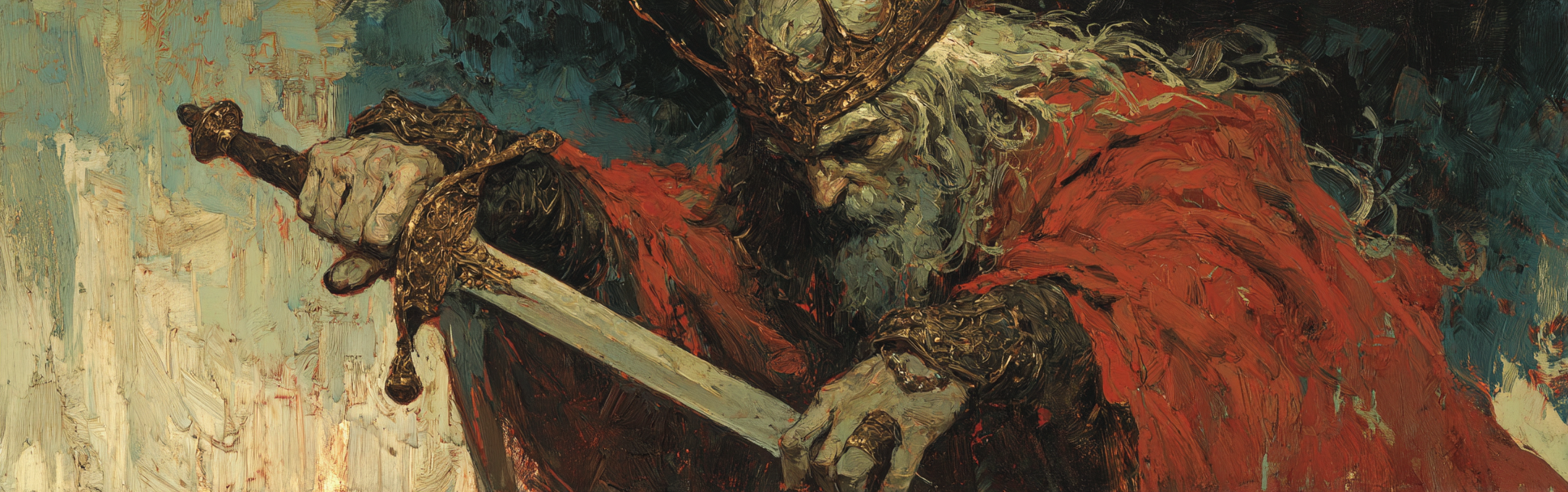
After Joe left my apartment that night and I was getting ready for bed, I was mulling over the idea of the “warrior king.” As usual, I had a fuzzy, general understanding of what I meant. I pictured a bearded man on a cliff, cloak whipping in the wind: dramatic, sure, but not helpful. I knew there was something about this idea that attracted me. This idea that I could be, if not in fact, then at least in ethos, a warrior king spoke to a deep part of me, and call it projection, but I felt that it would speak to other men as well.
Over the coming weeks I started playing with ideas of what the Warrior King Ethos is about. How could this idea help men order their life correctly, make identity-based decisions, or communicate their trajectory and philosophy in life to other men, their family and wife, and their community?
After hashing out the particular areas a warrior king ought to focus on, I found a common thread. The warrior archetype embodies askesis (from the Greek *askeo* - I train), which is the exercise of rigorous self-discipline. My perspective on discipline is a lot more nuanced than “try harder, deny yourself” but the word gets the point across. A man who is called to the life of the warrior king, as distinct from a man who is called to the monastic or clerical life, is called to deny himself, acquire skills and resources, and use all of this progress for the service of those whom God has put in his care.
The idea is pretty simple: Life is warfare (Job 7:1-2), and to achieve the purpose for which God has put him on this earth, I firmly believe a man must suffer. Suffering, which in our modern culture is seen as an ethical evil, is not evil. In fact, any Christian will know that suffering for God, the Church, or his family is good. One of the most glorious things a man can do is give his life for the Faith. By God’s mercy, most of us are not called to this end, but as my priest often reminds me, we are all called to some martyrdom. In the Orthodox wedding ceremony, both groom and bride are crowned with actual crowns which represent the crowns of martyrdom. We don’t exist in isolation anymore, but sacrifice ourselves for the other.
The only way to navigate this warfare *tactically* is through developing strength, skills, and resources. As a husband and father, I don’t have the luxury to denounce material resources or physical strength. I don’t have the luxury to be lazy when my wife and daughter need to eat, the light bill needs to be paid, or someone makes a threat towards my family. I don’t have the luxury to be wasteful or dismissive of money while my parish is experiencing financial instability. To put it plainly, askesis in this context is developing the capacity for ordered action and sacrificial endurance.
Anyone who’s read my first essay on practical philosophy will know that I believe the test of any true philosophy is the tangible, practical outcomes it leads to. This is that. Without the attitude of the warrior, taking life *seriously,* philosophy is useless.
The Seven Commitments of the Warrior King
Fast forward a few weeks. Joe, another friend of ours from church (let’s say Tim), and I are sitting in a booth at the Texas Steakhouse we visit every Wednesday night after vespers.
“Do you have a pen I could borrow?” I asked one of the waitresses, who swiftly produced one from the dozen or so she carried in her apron.
I grabbed a napkin and got to work. Since the initial conversation that produced the concept of the warrior king, I’d been going back over my previous methods and philosophies for life organization, and I’d begun honing in on a particular framework. Up until this point, I had a method of dividing tasks or focuses based on pillars. Money, body, art, relationships, mind, church, or alternatively self, others, work, or during some periods even body, mind, spirit, money, leisure, you get the point. Compartmentalizing tasks and picking goals for each *pillar* is something I’d been doing since college, and it served me quite well.
Something about the warrior king idea injected a certain sense of *objectivity* into these pillars, and I could finally see the categories that were needed, not just arbitrarily, but almost as if they were part of an ancient code that predated me.
“If you had to put these in order of execution, which order would you pick?” Joe and Tim found themselves looking at seven fragments of napkin bearing the words:
LEISURE | STEWARDSHIP | CRAFT | SPIRIT | MIND | BODY | RELATIONSHIPS
“Well,” Joe said, as he started moving pieces around, “I’m assuming spirit is Church and God, so that’s first. Stewardship has to be second. After work, gym comes next, so I’d say body.” After putting the third piece in order, he hesitated. He placed craft and mind next to each other, then below them relationships and lastly leisure.
“I’m not sure about craft and mind.”
“Neither am I,” I responded, but I was delighted that we’d independently come to the same ordering. Over the course of dinner, we kept discussing the difference between artistic/craft mastery and intellectual mastery, and ultimately settled on the order presented here:
- SPIRIT | Serve God and the Church
- STEWARDSHIP | Provide for Family and Community
- BODY | Build Physical Strength and Health
- CRAFT | Master a Craft and Create Beauty
- MIND | Develop Intellect
- RELATIONSHIPS | Cultivate Relationships and Leadership
- LEISURE | Enjoy the Fruits of Labor with Balance
And there it was. The seven pillars of the warrior king. Of course, based on the title of this section, you can already deduce that the name didn’t stick, primarily because when I wrote them out in full I found myself writing “My first commitment is to God…”, “My second commitment is to stewarding my resources…”, and so on, but you get the point. Based on our shared philosophy of personal masculine excellence, both Joe and I, and of course Tim, came to the exact same conclusion, that craft and mind aside, there’s a very natural order of operations in the life of a man.
Over the years, I’ve gotten some pushback on these categories as well as their order, so it’s important we state explicitly what the Seven Commitments are and what they aren’t. The best way to think about them is two-fold. First, the Seven Commitments serve as a rule of life in a similar way a monastic rule might. When adhered to, they produce the fruit that is necessary for success in worldly responsibilities without sacrificing the primacy of God and the Church in our lives. This tension had been a particular struggle of mine, but as I explained earlier, the reality is that a father and husband, or any man wishing to be, doesn’t have the luxury to turn up his nose at making money or developing physical strength.
Second, the Seven Commitments serve as the ordered sequence of training for any man who desires to serve well. They are *pragmatic*, not *ethical* in nature. The list should not be interpreted to mean that money is more important than social relationships or that art is more important than intellectual pursuits. Instead, the Commitments are in order of impact.
Think of it like this. If you could only serve one thing in your life, you could only pursue one field to excellence, what would it be? This one, of course, is actually ethical, but it’s spiritual progress. Every Christian knows this intimately. “What does it profit a man if he gains the whole world, but loses his soul?” the Lord poignantly asked in the Gospels. No amount of physical strength, monetary success, intelligence, and so forth can do anything for a man who isn’t in communion with God. It’s almost a truism. After serving God, what is the one thing a father and husband has to provide for his family and community? Well, it’s in the question: provision. It’s better to be physically infirm, unintelligent, socially awkward, and have no hobbies, but to put food on the table and a roof over your family’s head, than it is to have any of these but live on the street. It’s reminiscent of Maslow’s hierarchy of needs.
The same logic continues. Given that a man has a prayer rule, fasts, attends the services and works hard to provide for his family and community, the next most impactful field of mastery is physical. Health and performance give a man gravity and the ability to physically protect his family. After that, the further development of skills, usually artistic in nature, but also things like woodworking, gardening, bookbinding, are the next step on the road to excellence. It is better to be a man who can compose a beautiful piece of music than one who can list the most important composers of the 20th century.
After the first five commitments come relationships, and this again is a controversial ordering. Many men would have us place relationships higher on the list, either above craft, or maybe even above stewardship, arguing that a man who serves God will put the relationships in his life even above his ability to provide.
This is, to put it plainly, selfish. We’ve already pointed out that the Seven Commitments are not *value judgments.* The relationships in a man’s live are not *less important* than earning money. The point is that if a man has to work late to make end’s meet, but his friends want to grab a beer, what’s the right choice? If a man is invited to his niece’s birthday party but the cows need to be brought in for winter, what’s the right choice?
If a man is lonely and wants to meet a woman so he can eventually get married, but he doesn’t have enough income to provide for a wife *what’s the right choice?* The point is that the ordering of the Seven Commitments is about impact, not to rank human good. A man who prays and provides changes outcomes faster than a man who networks without income or reads without work. This sequence prevents self-deception: serve God → provide → get strong → build a craft → sharpen the mind → lead people → then enjoy. In that order.
In the future, I plan on exploring each Commitment in greater detail, but with them laid out in order and the thought process explained, you already have everything you need to order your daily, weekly, monthly, and annual activities in the way that’ll create the greatest impact for your family and your community. In the spirit of methodos, part IV of this essay will contain a cheat sheet for implementing the Seven Commitments in your life to make real, measurable progress.
Like them or not, the Seven Commitments *work.* Men who list them out and set goals for each, extracting daily routines from each goal, make progress. It’s that simple.
Part III: The King— Order and Dominion
**Order**: bringing things into right relation. **Dominion**: stewarding what God entrusts to you for others’ good.
Ordered Rule
After that fateful dinner at Texas Steakhouse, I got to work. I began consolidating my various interests and their artifacts into guides under the Warrior King umbrella and made them available to my friends. The Warrior King Training Protocol, the Warrior King Courtship Playbook, the Warrior King Attire Rules, you get the idea. Anything that had helped me become a more effective man in the practical sense stayed. Any other interests fell by the wayside.
I also started a podcast with short reflections that aired six days a week. When I burned out on that, I went to one day a week, but that medium didn’t serve me well (read: I was bad at it). Joe, Tim, and I started training together every Saturday, and they would invite their friends, who would invite their friends. Eventually, after one Saturday form clinic had 9 attendees, I had to cap the number at 7. There’s only so much form analysis I can do before my own workout suffers.
In short, my life kept moving in a direction of increased responsibility, and after God’s grace and mercy, the thing I credit most with this is a singular focus on the Warrior King Ethos, specifically the “King” portion. We already covered the concepts of discipline and struggle, but these make you a foot soldier and not a man worth following unless you bring the attitude of the king: order and dominion.
This is so central that I need to repeat it. **Discipline makes a soldier. Responsibility makes a king.** We’ve already started talking about stewardship and responsibility with the introduction of the Seven Commitments, but let’s take a closer look here. Any man can develop discipline and work hard. Any man can get ahead economically, become a great athlete, or learn to be charismatic and charming. It’s the ordering of the warrior’s discipline that turns a man from an egotistical, self-serving “sigma” into a proper patriarch. In order to lead well, a man has to have two qualities: the ability to lead, usually reflected in means, skills, and desire, and the proper conception of leadership, that is, servant leadership.
A man who wants to lead but has no qualifications won’t make a good leader. The desire to lead your family is necessary, but without the proper skills and resources, you can’t possibly dream of doing it well. I believe that virtually every man, in his heart, wants to rule over a household with self-sacrifice and competence, but if you don’t have the skills to provide, you’re better off not getting your wish.
A man who has the necessary qualifications, but doesn’t understand leadership also can’t do it well. Self-sacrifice can’t be forced. If a man has the means, the skills, and the experience to lead well, but he just doesn’t get it, being thrown into it is the worst thing that can happen, both to him and to those who end up suffering under his demagoguery.
Responsibilities find the man who has both qualities. This is a mercy. Over the last 15 years, I’ve been in a number of relationships, from high school all the way past college. Some of them were short, others years long, but until I met my wife, none of them were on the path to proper order. It wasn’t until December of 2022 that I decided, for the first time, to truly try to become the man who could actually lead a woman and a household. I don’t think it’s a coincidence that I met my wife 2 months later.
Kiss the Ring
When it comes to the double criteria for kingship in the context of the ethos, order and dominion, the clarity a man has regarding them is directly related to how well he can bring them about. In other words, *you can’t hit a target you can’t see*. I imagine that if I’d had a father, and a good one at that, he would’ve taught me this in some way. Any Christian man will have an intuitive understanding of *ordered* vs *disordered* life, but it’s making the intuitive explicit that can sometimes be difficult.
We can resolve the ambiguity here with our usual method, by looking at the practical activity that would signal a healthy life. When I became a Reader in the Church, the bishop who tonsured me told me “now that you’re a reader, you’re under obedience to your parish priest, not to the same degree as a monastic is to his abbot, but to a greater degree than a lay person at the parish.” Since my parish priest is also my spiritual father, and I trust his judgment in all spiritual matters (he’s been a priest about as long as I’ve been alive), this didn’t change much for me, but it illustrated one of the timeless laws of authority.
I call this “kissing the ring,” that is to say, showing respect and deferring to authority in all forms blessed by God. In the clerical ranks, a priest submits to his bishop, a deacon, subdeacon, and reader submit to their priest, and all of them submit to God. In turn, for those who are married, their wives submit to the husbands (Ephesians 5:22), and both submit to God. The children submit to the mother and the father.
I, as a man, have both people who submit to me, and those to whom I submit. This is true for almost every man. We all have obedience to someone, and if we want to be good leaders, we must first be good followers. This is proper order. In the life of the man following the Warrior King Ethos, this manifests in the following hierarchy:
- Man is ruled by God and His representatives (submission)
- Man rules himself (self-mastery)
- Man rules his domain (leadership)
Only when the first two conditions are met can the third condition come about in a natural and healthy manner. It’s important to note here that dominion is not domination, it’s stewardship. All things we’re given as men, material possessions, a wife and children, etc., are *borrowed* not *owned.* To echo the definition from above, order is bringing things into right relation. We must always understand our relationship to God, ourselves, and others, and only in this way can the skills and resources acquired through the warrior’s askesis be used for kingly order.
It’s both the abilities and the rightly ordered aims of a man that make kingship unique from tyranny. Tyranny is control for your own sake. Kingship is control for the sake of others.
The Burden of Rule
Until this point, it might seem like the Warrior King Ethos was developed through a sequence of wins, but every story has its tragedy. Joe and I left the parish we were attending with Tim over what we considered to be severe departures from the historic Orthodox Faith and found a new place to call our spiritual home. Tim stayed back, and after more than a year of working on his career prospects, training hard enough to deadlift more than I do, and meeting a girl and getting into his first relationship by using the Playbook, he regressed without proper masculine community.
This exodus of men from our parish to a new one was one of the most painful experiences of my life. I remember standing in the parking lot of my church, tears in my eyes, trying to explain to my then parish priest why my only option was following my conscience. As a man, if you don’t have principles, you have nothing. He didn’t understand, but he didn’t have to. Shortly after this conversation, Joe had one very similar to it with this priest.
Out of my group of brothers at this parish, numbering somewhere between 9 and 13, only 3 of us left. Every single one of these men agreed that what had transpired (and was continuing to be endorsed) was in no way Orthodox. Yet only a fraction decided to take action based on this information. Sadly, Tim wasn’t part of that fraction.
After this, Joe and I continued pursuing the Warrior King Ethos. We kept training, kept serving at our new parish. For more than a year, I drove 90 minutes one way, slept on couches, in hotel rooms, and in AirBnBs just to attend vigil and liturgy at my new church. During the transition from my first parish to my current, I met the woman who would become my wife and the mother of my child. I also began serving in the altar, serving on the church council as treasurer, and I was tonsured a Reader.
I thank God for the ways in which He’s blessed me, and it’s easy to see the connection between my new parish and the beautiful things that have happened, but the point I want you to focus on is that none of these blessings, my wife and child, joining the ranks of minor clergy, serving my parish, would’ve happened had I not followed my principles. This is foundational to the actions of the king: **real leadership hurts sometimes.**
Compare this with the modern ethos. Men want visibility, not responsibility. They want influence without the burden of being held accountable for that influence. Far too often we want to be *comfortable* more than we want to be *moral.* I’m the first to be guilty of this. That’s why I’m mentioning it. Without a sober understanding of this tendency to hide, to shift blame, to respond with “he made me do it” or “I was forced to,” no man can possibly hope to make any actual progress in his ability to lead.
There comes a point when we need to ask ourselves as men if we are hiding behind our apathy. Does the fear of responsibility, *true* responsibility, lead us to shirk our duty, repressing our calling to lead, which makes it manifest in unhealthy and distorted ways? In my personal experience, the frameworks and ethics of our culture encourage this. It’s as if the entire male population is suffering from a souped up observer effect: we all see the problems our inaction, both individual and collective, is causing, but no one wants to take the first step and speak up.
To quote the famous lyric, “where have all the good men gone?”
Part IV: Integrating the Ethos
Cultivating masculinity
If you made it this far, congratulations. You now know both the back story (roughly) and the ideas of the Warrior King Ethos. At this point you should also understand how this framework can help you become a more effective man like it has for me. If the practical nature of this philosophy isn’t obvious yet, this section will remedy that and give you all the tools you need to start using the Ethos and the Seven Commitments *today.*
Like any good philosophy, this ethos does double duty in that it defines what the goal should be, then provides tools to achieve it. Though not a philosophy in the strict sense, Orthodox Christianity, for example, teaches us that the goal of human life is union with God through the acquisition of His qualities, *theosis.* It also provides us with many tools to achieve that goal. The divine services, the lives of the saints, prayer rules, the holy mysteries, icons, books, prayer ropes, etc etc. This is the standard to which any philosophy worth following must be held. It should answer two questions
*1. What should I do (and why)?*
*2. How do I do it?*
To recap, the Warrior King Ethos is about developing strength, leadership, and mastery guided by faith, so you can bring about genuine legacy. In some ways it’s the *practical* moral architecture MCX endorses, not in the same sense as the Christian faith, but in a more mundane fashion. Christian morality is eternal, absolute, unchanging, rooted in God Himself. The Warrior King moral architecture is about the specific point in time we’re in, that is, 2025. What are your specific circumstances? How can you make a real impact and bring some good into your community or family? What skills do you need to develop to keep your wife and kids safe?
This ethos is about *cultivating masculinity.* Masculinity is not one side of a coin with femininity as the other. Masculinity is a true and objective good. Just as femininity is (in its own way), but they are not yin and yang. To quote C.S. Lewis from the space trilogy: “what is above and beyond all things is so masculine that we are all feminine in relation to it.” God is the ultimate masculine, the provider, the progenitor, just, and merciful, but we are not God. Whereas God is like this by nature, a man has to work to acquire this state.
A man living the Warrior King Ethos has to **train like a warrior, think like a philosopher, and lead like a king.** (That’s why it’s on the title page of this website.) Together these *activities* cultivate certain *qualities* and sharpen the man and his faculties. The actions themselves become training for who you’re meant to be, but also their outcomes make you who you’re meant to be. It’s perfectly efficient.
The Tactical Warrior
The easiest way to turn all of this into action today is to grab a notebook, open up a google doc, or (as a friend of mine told me he did) find a marker and a small white board. I’ll talk you through the process I’ve been using for 3 years and provide a template you can copy and paste at the bottom of this section
Write the Seven Commitments down the left side, and for each commitment, write what you want to have developed, acquired, or brought about in that category in the next 10 years. What monetary or familial stewardship goals do you have? Do you want to move up in your company to get a raise? Do you want to save up for a home? Do you need to reorder your finances, sell your fancy sports car and buy a truck (I did this, go tundra). What kind of physical achievements would make you a better man? Is it losing some weight, or gaining some muscle? Are you stiff and inflexible, or do you tend to eat junk food every weekend?
What about craft? Do you never take time to practice the guitar and play music like you used to? Do you have that “how to write fiction” book sitting on your desk from six years ago? The good thing about craft is that it sometimes can double as leisure, but be careful that you don’t turn craft practice into play hour or leisure time into another goal driven endeavor.
The point of all this is that if you try hard enough, you can see in your mind’s eye the kind of husband your wife deserves in ten years and the kind of father your children would benefit from. Once you have your ten year vision declared, you write what you need to get done *this year* to move you closer to that goal. if your goal is to own a home within the next ten years, your first step can be getting your budget in order or getting a higher paying job so you can start saving. Or you might want to leave the work force and start a business. This year could be about developing the skills to do that, or starting a free youtube channel, podcast, or website.
Once you have the yearly goals, you’ll repeat that process for this quarter, and then every week as well. But the goals alone are not what make this effective. You’ll take each goal and extract a metric and a drill from it. For example, if your goal is to buy a house, the metric may be % of downpayment saved. The drill may be a weekly financial review. If you want to do a 2x bodyweight pull-up, the metric is weighted pull-up max and the drill is pull-up session 3x a week. You get the idea.
Here is the tactical template you can use or modify to make real, measurable progress towards masculine excellence:
```
SEVEN COMMITMENTS → METRICS & DRILLS
-
SPIRIT — Serve God and the Church
Metrics: consult your priest.
Drills: consult your priest.
-
STEWARDSHIP — Provide for family and community
Metrics: savings rate %, emergency fund months, giving %, career leverage moves/quarter, net-worth ÷ monthly expenses (target 25:1 for FI).
Drills: Sunday money meeting; autosave to 3 buckets (emergency, investing, alms); quarterly resume/portfolio upgrade.
-
BODY — Build physical strength and health
Metrics: big-3 totals or weighted calisthenics PRs; # cheat meals / week < 3; sleep hours ≥ 7.
Drills: WK Training Protocol 3x/wk; 10k steps/day; lights-out window.
-
CRAFT — Master a craft and create beauty
Metrics: focused hours/week; artifacts shipped/month; critique cycles/month.
Drills: 90-minute deep-work block daily; “ship on Fridays” rule; monthly master-copy study.
-
MIND — Develop intellect
Metrics: pages/day; memorization lines/week; notes distilled/week.
Drills: 30-minute reading block; commonplace notes → weekly synthesis; 1 longform essay/quarter.
-
RELATIONSHIPS — Cultivate relationships and leadership
Metrics: 1:1s/week; date nights/month; mentoring touches/month.
Drills: weekly call list; scheduled date night; men’s table + supper cadence.
-
LEISURE — Enjoy the fruits of labor with balance
Metrics: leisure hours budgeted/week; outdoor hours/week.
Drills: pre-planned leisure list; screens off after dinner; one wilderness day/month.
```
It can really be this simple. Get a notebook and put each of these on a row. Write the weeks across the top and fill in your performance weekly. You can also extrapolate these into daily habits and track daily, whichever method you prefer (some temperaments prefer structure and logic more than others. I’m part of the group that thrives on data).
The purpose of this practice is readiness, to be an effective steward of others’ well-being. Like I said earlier, when you systematically and consistently pursue growth in all of these areas, always judging which priority comes first, the Seven Commitments will naturally steer outcomes into the most beneficial direction they can go.
One distinction that i *have to* make is that **this is not about self-improvement.** In the generic sense, some of the activities of the warrior king are the same as those of a self-help warrior, but the motivations are polar opposites. For the self-improvement crowd earning more money, getting in shape, or learning to play the piano is a desperate attempt to inject one’s life with meaning. For the man practicing the Warrior King Ethos, life’s meaning is obvious. Serving God well for a family man requires certain skills, resources, and attributes, and we’re simply pursuing them *ordered rightly.*
Saying that since the ethos endorses similar activities to the self-improvement space they are the same thing would be like saying that both hunting and first degree murder are the same thing because both involve pulling the trigger on a firearm. It’s preposterous.
The reality is that when you grow steadily across the Seven Commitments, you become more *useful*. You become the kind of man who keeps the lights on, owns the room, and stands between danger and the people who trust him. The work itself is simple: Pray. Save. Train. Build. Read. Lead. Rest. But the reason matters. The drills exist so that when life goes crazy, you already know what to do.
Every habit brings both tangible benefits, and character shaping. Training teaches discipline. Budgeting teaches restraint. The prayer rule teaches humility. Even leisure teaches gratitude. A man who practices daily in this way becomes steady, immovable, and ready for service.
Conclusion
So here we are today. I’m sitting at my desk in the house I bought last year, a luxury most of my friends have not been able to afford. My wife is downstairs with my daughter. She doesn’t have to work, so she can focus on raising our current and future children and keeping the house in order. I can therefore focus all of my time on becoming the man who can provide for this family and my home.
Through more than a decade of intentional work, I’ve been able to create a simple life of service and meaning. I get to write essays like this to share my ideas, work in a good career, attend most church services at the parish 409 feet from my house (yes, really), and spend time with friends and family. I’m always looking to improve, to build something better, and to serve God in whatever ways he wants me. Sometimes it’s hard, other times it’s easy, but it’s always worthwhile.
This is the way. Every man in the world has to embrace what God made him to be. The good news is that when you find it, it’ll feel like the most natural thing in the world. Maybe you’re called to be a monk or a priest, in which case this essay was probably a waste of your time (thanks for reading, though). Maybe you’re called to be a family man, a husband and a father. In that case, you now have the proper system to make things happen. People have a tendency to overestimate what they can do in a year but underestimate what they can do in a decade.
Work steadily, obey God, rule over yourself, lead your household, and defend the good. You do this through consistent, daily choices that build strength, wisdom, and love. To quote James Clear: “every action you take is a vote for the kind of person you wish to become.” Vote correctly.